VID · Walk & Talk · Episode 1

Why full-AI costs twice what a hybrid shoot does.

Every generator ad says AI makes fashion imagery cheap. Our production data says the opposite: done properly — with consent gates, garment lock, and recorded royalties — full-AI is the premium lane, and multiplying a real shoot is the economical one. The founder walks the entire machine on camera.

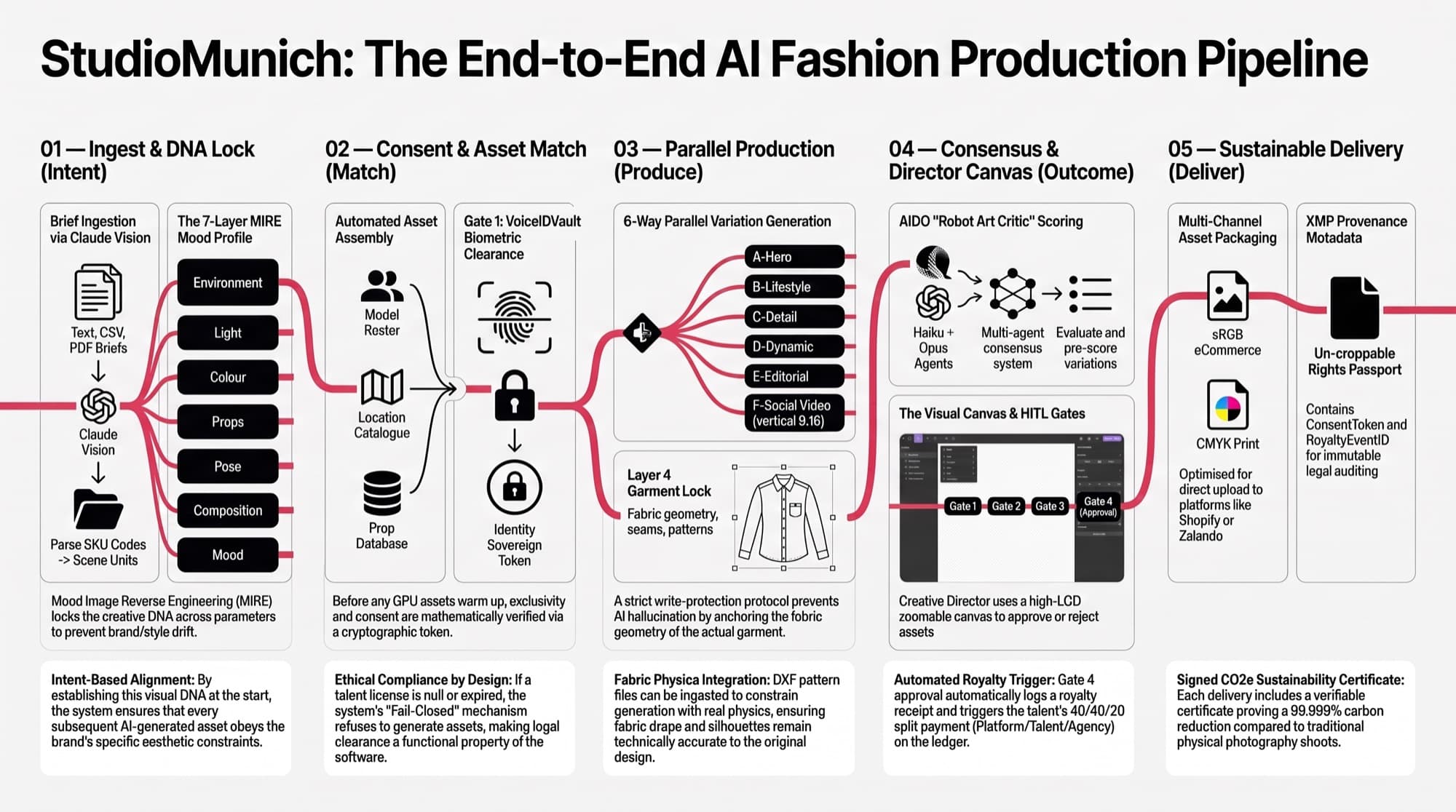
StudioMunich end-to-end AI fashion production pipeline: ingest and DNA lock, consent and asset match, parallel production, consensus and director canvas, sustainable delivery

The five-flow production architecture the episode walks through — brief to rights-passported delivery.

31 minutes · 13 chapters · produced end to end on the StudioMunich rail — the episode is itself the product demo, down to the founder's sweater being recolored on screen.

How much does AI fashion photography actually cost?

On StudioMunich's public pricing, a fully-AI-produced catalog unit costs 95 credits end to end, while multiplying an existing shoot — semantic colorways at 20 credits, re-dressing, format derivatives — costs a fraction of that per finished image. That is why the platform's position is a hybrid one: shoot once with your own team, then multiply that shoot at catalog scale. Rights are part of the cost honestly accounted: consent is verified before generation and talent royalties are accrued and recorded on a 40/40/20 split at approval.

Credits per production unitBar chart: Full-AI mode 95 credits, E-commerce dress 65, Hybrid re-dress 45, Semantic colorway 20 — full-AI runs more than twice the hybrid rate.Credits per production unitFull-AI mode95E-commerce dress65Hybrid re-dress45Semantic colorway20095 cr
Full-AI is the premium lane — more than 2× the hybrid re-dress rate. The volume lives in multiplying a real shoot: re-dress at 45, colorways at 20. Public prices; packs never expire.

≈ 2×

Full-AI cost vs a hybrid shoot, per finished image

A full-AI unit runs 95 credits end to end. A hybrid rail re-uses your real shoot: the derivative work — re-dress, colorway at 20 credits, format cuts — is where the volume lives, at a fraction of the per-image cost. That is the episode's whole argument: the shoot is not the expensive part; refusing to multiply it is.

40 / 40 / 20

Recorded royalty split: platform / talent / agency

Every approval fires a recorded royalty event on this split. Talent in AI imagery earns per use — enforced by the pipeline, not by policy.

0:00

The AI catalog dream — and why it fails

Imagine you're running this massive fashion brand. You've got thousands of products to shoot for your new collection for the new season. Intuitively, you'd assume that using artificial intelligence to just generate your catalog entirely from scratch would save you an absolute fortune. And that's the dream, right?

But no physical models, no light and cruise, no booking flights to exotic locations. You just type a prompt and you're done and the computer just imagine the rest and you pocket the difference. But the reality, and according to the architectural blueprint that I have linked for you down below if you want to connect, download it, it obviously using just AI basically costs them more double. So it's a paradox of this whole new generative area.

Having this assumption that information is just free for a machine, it costs nothing. But in the math of high-end commercial rendering, physical reality is still the most efficient computational shortcut on earth. And that counter to reality is exactly what I want to be talking about today. So we share a document which is this claim registry safe product walkthrough from Studio Munich.

So it's not a standard software update ultimately. So let's look at it closer because it's a complete fundamentally re-engineering of the photography industry. We're looking at a full end-to-end blueprint for what we call a hybrid catalog. Incredibly rigid ultimately where we merge physical studio inputs with very strict AI automations.

1:08

The architecture in five phases

And it essentially aims to solve the two biggest nightmares of AI in e-commerce being losing your brand identity to AI hallucinations and then the ethical, legal, minefield of human talents, the models. And that's a huge deal right now. So I'm going to explain and explore how we pulled it off basically. So let's talk about the architecture in five phases, how we built it around human talent before a single picture was actually rendered, that upstream engendered and talent rights government, governance, sorry.

and then how we extract the physical DNA of the garment and then we'll show you how we push it through this unyielding 15 step automated factory basically and then filter it through human art directors and creatives human in the loop and how we pay for it ultimately transparently So let's get into it. The overarching theme here I would say is control. If you look at the first section we are covering, upstream ingestion, the process isn't actually begin with a camera. It begins with translating vibes or the briefs into data.

So a creative director submits, or the client submits, a brief, a PDF with mood boards, color palettes, or sometimes the photographer depending on whose responsibility it is, so standard agency stuff. But what our system does, it passes the human readable brief using that to systematically map out the entire production run. So it assigns specific requests directly into these designated classes in a little bit technical. So planning the campaign ultimately before anything is shot, so the storyboard.

So the critical piece of this upstream phase isn't just the mood board passing, but it's what we designate as gate 1 governing biometric consent and talent licensing. And it sounds like the ultimate digital bouncer at a nightclub to use that analogy.

2:32

Gate 1: the digital bouncer

The gated production flowFlow: Brief, then Gate 1 consent check which fails closed with no active license, then rendering under the Layer-4 garment lock, then Gate 3 automatic face-consistency scan, then Gate 2 human art-director review, then the receipt: a recorded 40/40/20 royalty and a hash-signed CO₂e certificate.Nothing ships unseen — the gated flowBriefintakeGate 1consentRenderL4 garment lockGate 3face scanGate 2art directorReceipt40/40/20 + CO₂eno active license → no render (fail-closed)royalty recordedon approval
Consent is checked before compute — Gate 1 is enforced by the platform, not by policy. The two review gates catch drift (automatic) and taste (human) before anything reaches a client.

So before anything happens, the system checks the biometric list. And if your paperwork is in flawless, the machine, the AI will simply not open the door and you can't get through into the club. And it's fascinating because it removes human temptation entirely. So let me explain why human temptation.

So think about a traditional agency. If a massive deadline is looming, an account manager might quietly ignore an expired contract just to get the campaign out the door. So they'll say, you know, we'll fix it later. And that means the Studio Munich Blueprint ultimately explicitly states that no active license means no render.

So the code itself refuses to execute. It's a hard-coded block on the compute layer. So you understand the mechanics of this. Let me explain.

If a model's licensing contract expires at a certain date, And a rendering job using her likeness is halfway through processing right at midnight. What actually happens? The generation sequence terminates mid-sequence and basically just stops. So the platform physically cuts the compute resources because the authorization token that's attached to this biometric profile for that campaign editorial or commerce job physically stopping and preventing unauthorized renders enforcing what we call zero drift digital likeness rights now it's a mouthful But the model's identity is locked and protected continuously.

So a staggering level of protection leading to the royalty mechanics. So the system automatically reports the usage and locks discrete royalty events against that gender. So we have a specific split which is a split for the actual commission. X goes to the platform, X to the agency and of course X to the talent.

Trig it automatically when the client approves and pays the final production. So think about the historical context to appreciate it. Tracking usage rights for models across different regions, different time frames and time zones, print versus digital, commerce versus commercial, it's a total nightmare. So agencies have entire departments chasing down which contracts are used and where.

By hard-coding these royalty events into the rendering pipelines, Compliance isn't something a legal team checks afterwards. It becomes an automated byproduct of the actual rendering work itself. So let me challenge you might think of someone who follows e-commerce scaling closely. The whole selling point of AI is supposed to be frictionless speed.

4:23

Friction upstream, speed downstream

So doesn't pausing the entire machine for a mandatory human decision like at gate one, you know, running constant biometric ledger checks, doesn't that inject a massive bottleneck into what should be a instantaneous workflow? So it seems counter-intuitive to add friction up front, but placing this bottleneck entirely upstream actually massively accelerates the downstream process. So let me explain. Let's look at the alternatives.

Imagine you generate 10,000 catalog images in various different collections, locations. scaling them globally across markets and then your legal department discovers the agency didn't clear the model's rights for that European market for instance so obviously a disaster catastrophic legal bottleneck and you have to scrap the massive compute cost you already spent renegotiate or you face massive losses so tearing everything down So by placing this rigid gate before any rendering power is spent, we guarantee that every single asset emerging from that pipeline is completely legally bulletproof. So slower at the start to ensure zero speed bumps at the end. So the human talent is legally cleared and their payments are automated.

And that brings me to the garments itself, the collection. So, and that introduces the second section today, which is visual extraction and digital DNA. Because if the AI decides to get quote-unquote creative with the designer's dress, the brand is obviously ruined. So how does Studio Munich translate a physical garment into code without losing its DNA ultimately?

And this happens through what we call our Myer architecture, M-I-R-E. standing for multimodal image representation and extraction. Historically, if you wanted to isolate a garment from a background, you set the photo to a production studio, they put it on mannequins and shoot all the imageries and then 3D render it and then you could put it onto the model. What we do, we replace this entirely with what we call a Byrith engine.

I'll get into it later.

5:54

MIRE: the garment's digital DNA

But what it ultimately means, it doesn't... How is it fundamentally different? Let me explain that. So it's not like the magic wand tool in Photoshop.

So what happens under the hood? The standard Photoshop tool just looks for color contrast. It sees a white background and a red dress and it just, you know, masks the lines, snaps to the grid. But what we do, it's a specialized neural architecture, neural network architecture that understands depth and context.

It doesn't just look for flat edges, it calculates foreground versus background mathematically. And this allows for unbelievable edge precision around a credibly context boundary. So think of boundaries like stray threads or translucent chiffon, silk, any type of material, you know, or fuzz or no wool sweater. It isolates all of that without any human intervention.

So extraction is part of the equation. But once we, you know, fragestelt, as we say in Germany, like, I can't think of the word to be honest, but once we decomposed it into a constraint, which is the core of our visual governance. So let me talk about these seven steps. We're not just saving a flat 2D image with a transparent background like a PNG.

M-I-R-E calculates the mesh, the illumination, the reflectance and the environment. So there's a lot of layers. It's mathematically interpreting how light bounces off that specific textile texture. And it maps the micro geometry of the stitching ultimately, so vacuum sealing a physical object's reality ultimately.

So we are trapping its exact lighting texture in this digital securely. So it's like the brand book lock ultimately. So once the 7 layer profile is created, that single file carries the entire collection from the initial buyer's material all the way to the consumer's software, to the B2B and B2C side. across all the downstream generative paths, meaning the aesthetic physically cannot drift, not even a little bit.

So whether the system generates an image of that dress in a Virgin Parisian cafe or on a beach, The garments texture, drape and baseline lighting parameters remain perfectly anchored to that original physical scan. And that's how we standardize the environments that we put the clothes into. The blueprint, what we call the governance artistic shock clad governance, Basically broken down into five classes. A, the hero shot for bullboards.

B is lifestyle context. C is detail focusing on the fabric. Class D is dynamic motion. And lastly class E is editorial, like magazine grade imagery.

7:53

Five shot classes, one continuity

and the entire purpose of hard coding these classes is to maintain strict catalog visual continuity and you know think of a traditional physical shoot a photographer manually swaps lenses they adjust the depth of field they shift the framing to get all these variations and it's never exactly the same twice Human variance means no two shoots will ever look exactly alike. So by standardizing these classes, we are essentially turning the role of a traditional photographer into an API essentially. So if an art director requests a classic detail shot, the system guarantees the exact same camera focal length. An exact same depth of field constraints across an entire 500 frame catalog, stripping away unpredictable variances of human photography.

and it strips away the wild hallucination of standard AI, replacing both with this industrial grade standardization. So we have the legally clear talent. We now have the perfectly extracted, mathematically locked digital DNA of that garment. Now we put them on the factory floor, which takes us into the third section of this documentation, is the pipeline and the industrial scaling, ultimately the engine room.

So the 15 step sequence is designed for our hybrid path. Sequentially bridging the raw physical studio and puts the AI node expansion, the render sentruses and the final finishing into one yielding pipeline or workflow. And we're obviously doing a lot of lifting under the engine. It provides a real photograph of a real model wearing that specific garment shot on a very simple grey or white set initially.

So the system keeps the physical model and her pose, but it uses AI to completely replace that simple set with a generated world based on that creative brief we spoke about before. So we also have this location composite feature so you can actually upload a reference picture of the physical location like a flagship store in Munich provided you have the rights.

9:25

The 15-step pipeline

The factory, both lanes — every step exists in the deployed application

Product 1 — Virtual try-on (catalog scale)

  1. 1Ingest & isolatebirefnet background removal — the garment becomes a clean digital asset
  2. G1Rights-cleared castingbiometric consent license verified — no active license, no render
  3. 2Lock the MIRE DNAenvironment, light, pose locked as a 7-layer constraint — the set cannot drift
  4. 3Virtual try-onHY-WU drapes the garment; Layer-4 Garment Lock write-protects the product's geometry
  5. 4Colorways by voice“Change the dress to navy” — fabric color only; geometry & scene stay locked
  6. 5Deliverychannel crops, sRGB, XMP provenance in every file — Shopify / marketplace ready

Product 2 — Hybrid catalog (15-step job)

  1. 1World firstlocation, brief, moodboard before shoot day — the photographer shoots INTO the scene
  2. 2RAW + MIRE extractionreal photography in; every photo decomposed into the 7 MIRE layers
  3. 3The Hybrid Pathher body, her pose, your garment — the AI replaces only the simple-set world
  4. G3Face consistencyautomatic scan across all variations — mismatches flagged before any human sees them
  5. A–EFive shot classesHero · Lifestyle · Detail · Dynamic · Editorial — one continuity
  6. G2Art director reviewhuman approves, rejects, or requests a variation — nothing reaches the client unreviewed
  7. 5Sign-off & receiptproofing corridor → royalty event (40/40/20) → hash-signed CO₂e certificate
The shared rails: credits debit before work happens · consent can refuse mid-engagement · every render receipted, royalties accrued and recorded · hash-signed CO₂e certificate per job, publicly verifiable. This is the diagram the gated blueprint download expands on.

And the pipeline deposits the model into that specific environment. using depth-aware placement, meaning the AI understands that she should stand, for example, behind the street but in front of the cafe window and adjust the lighting to match that exact spatial placement. And you might think of a pushback on the technology here because anyone who's played with AI image generators know they love to improvise and they inherently want to fill in the likes. So what happens when the AI hallucination kicks in and decides to add a cool non-existent zipper to that skirt?

Or it invents an extra seam on a dress because mathematically it decides it improves that composition. In fashion e-commerce that is obviously a catastrophic failure. You cannot sell a product that doesn't actually exist. And this is obviously the reason why we built the layer 4 garment lock.

What does that mean? It's powered by our HYW engine. So let me explain this engine. So, you know, we use the acronym and I haven't actually explained how it stops hallucination.

How does the computer know a scene doesn't belong there? The HYW engine works in tandem with this 7 layer MYU layer I explained earlier.

Gated download

Download the StudioMunich Production Blueprint

The 15-step factory from this episode as a one-page reference: every stage from flat-lay to rights-passported delivery, with the gates marked. The document every chapter of this episode walks through.

Your copy is issued personally — stamped with your name and its provenance, the same way every StudioMunich delivery carries its rights passport.

10:21

Layer 4: the garment lock

It explicitly right protects the structural geometry of the product, like a file in your computer for instance. When the AI is expanding the nodes to build that cafe background, the layer 4 garment lock basically acts as an impenetrable fence around the pixels of that dress, forcing the generative model to treat the garment area as read-only data. What does that mean? The AI is allowed to calculate how the ambient light of the cafe reflects off that dress.

It can change the lighting. But it is strictly forbidden from altering the topography or adding any structural details whatsoever. So it's putting a fence around the product while letting the AI just run wild in the background. And that deterministic automation is what actually eliminates brand drift across thousands of high volume skews, unlocking staggering operational efficiency.

We completely eliminate the set rebuilds, we eliminate lighting delays and those endless manual retouching cycles literally fall away. And the feature which I like the most is, you know, the colourised by voice, so catalogue timelines, upended. Because you just issue a command, you say, change the dress colour to something else by speaking to it. The system identifies this specific material layer within that read-only garment fence altering only the fabric color property.

Stragic geometry stays locked, the lighting stays locked, the background stays locked. and you can generate three different color ways, seconds apart, with the exact consistency of a single physical photo shoot. So think about the physical alternative. The model has to go to the dressing room, change into the navy version, come back out, reset her exact pose, you know, impossible.

So that's why we shoot so many versions of that image. So that takes hours obviously, and here it just takes a couple of minutes. And this pipeline is actively expanding as we speak. Integrations for advanced physics simulation or garments physics simulation, what we call the DF-X tier, we're combining that with automated multi-angle video compilations directly in our pipeline graph.

So let's talk about the DFXT, so you guys understand what I'm talking about. Typically a file format used by architects and engineers for 2D and 3D CAD models. So how does that apply to this dress? In modern fashion design, garments are actually drafted in CAD software before ever physically sewn.

That means those DFX files contain the exact mathematical pattern pieces. They also contain the physical properties of the fabric, like what kind of properties, its textile strength, how it shears, how much it stretches. So by feeding that data or that DFX data into our pipeline, When the platform generates those video lanes, the AI isn't just guessing how the dress moves, it actually knows. It's calculating the literal physics of that specific fabric, draping over a moving bodysuit.

So we're moving from still to dynamically lit, physically accurate video lanes bound by the same unyielding pipeline. So that's a mouthful.

12:38

DXF: real pattern physics

Machines are powerful doing 15 steps of mathematical rendering, but they can also output content that feels soulless. So it could be aesthetically cold and robotic. So where does human taste actually come back into the picture? And this brings us to section 4, human in the loop, art direction and quality gates.

Because total automation is obviously fabulous for e-com throughput, but terrible for qualitative judgement, so a machine doesn't have taste. And we account for this by embedding strategic review checkpoints where the creative director and clients must sign off. And that takes us to gate 2. Basically meaning nothing reaches the client unreviewed.

So the human in the loop step. So the human art director reviews every single image. approve, reject or request a variation. Normally the client is on set talking about this or the creative direction on set without breaking the creative throughput.

So they might look at a render and say the ambient light in this cafe is just a little bit too warm. Cool it down slightly, you know the photographer will be doing most of that so micro corrections to the environment while automation still handles the heavy lifting of the physics and the extraction. So, you know, we've spoken about the automated pipeline as it ensures the entire workflow works and runs smoothly ultimately. So the human art director is still the one applying the spin, adjusting angles, and working with a photographer to make sure that this image is the creative vision of the client according to the brief.

So the human manages the nuance, and the machine manages the pipeline.

13:48

Gates 2 & 3: taste and anatomy

So we also have automated intervention points specifically designed for defect rejection, so safety nets. What it basically means is this is gate 3. We scan every output frame using facial algorithms before the human actually ever sees it. So it compares the generated face against the model's portfolio.

If there's a mismatch, say the eyes are to close or the jawline is short and whatever the imperfections might be, the system flags that a crucial defence mechanism for the talent because it's their ID, facial identity or personal identifiable information. So if the AI suddenly distorts their anatomy across a thousand catalogue images, damages their public portfolio. So Gate 3 serves as an algorithmic safeguard against those anatomy anomalies. checking for unnatural draped defects and once it clears the face scan and the human art director approves the vibe and the mood it finally goes to the client and we at Studio Munich have built a token corridor which is a completely frictionless proofing environment Clients get a secure token link that can view the assets, pin specific comments directly onto the fabric in the image, and they don't even need to create an account to do that.

It removes all the friction and administrative friction for the approval process. So it closes the loop between the automated factory and the photographer and the final product. So this imagery is ingested, extracted, rigidly controlled and approved by both algorithms and creatives. So that's the journey.

But we have to return to where we started at the beginning. the costs. So from an operational perspective, how is all this computing power, the platform fees and the human royalties actually paid for? Which brings us to our final section, Financial Mechanics and Credit Cost Architecture.

And this is where the unit economics of AI compared to physical photography truly reveal themselves. So what does this all mean for the bottom line? The platform operates on a rigid credit system. And the checkout constants we've made public is quite fascinating.

So go look at the pricing page. The hybrid production where you start with a real photograph in a photographer and his team, and then you shoot in the studio and generate the team around it, costs around 45 credits per render, excluding the fee of the photographer in the studio. but ground up full AI rendering where you hallucinate the model, the clothes and the environment for absolute zero cost 95 credits because it costs more than double the cost of the hybrid pack and you might think why you know you thought full I would be cheaper because it comes down to the sheer computational weight of hallucination versus alteration Anchoring the pipeline to a physical source asset is way more efficient. When you use that Myer architecture to extract a real photo, the machine already has the hard data, so it doesn't have to invent it.

It knows how the fabric folds, it knows how the light hits the cheekbones, it knows how gravity affects the hemline, reading reality ultimately. So it requires significantly less brute force compute power to just calculate a new background or an object.

16:09

The credit economics

then it does to force a neural network to completely invent a human skeleton, then drape a mathematically garment over it in 3D, and then render it all without introducing a single defect. So single reality saves the machine from doing the hardest math, essentially. And this is the inversion of how we basically assume AI ultimately works. And the approach for billing for this compute power is equally unforgiving ultimately.

So let's look at the debt-free credit debiting system. Credits are deducted in real time ultimately per compute stack before the rendering work ultimately continues. So it takes that money from the account instantly. If the agency's account has an insufficient balance, the run stops immediately.

There's zero debt permitted on the platform ledger. And that's obviously sounds a bit harsh, but you know, you're obviously used to net 90 payment terms. But think about the scale. If you're an agency partner running 30,000 high volume SKUs, through an automated pipeline overnight and say a scriptical edge cost is the computer to run twice.

You could wake up to a multi-million dollar or euro budget destroying bill from the cloud provider. So debiting upfront actually prevents operational budget overruns entirely, and it also enables a unified, completely transparent financial ledger. Because when those compute credits burn to generate the image, the system is simultaneously reconciling those costs against the downstream talent roles I discussed in Gate 1. mathematically settling that split, as we said, between agency platform and client.

And when everything's financially settled, the final deliverables are ultimately generated, the output. The client gets their files in SOGB, depending on the output, ready for immediate upload to Shopify, Zalando, or whichever e-commerce platform you link to. but you also receive something deeply embedded in the file an XMP provenance record. So the XMP stands for Extensible Metadata Platform and this context adds or acts as a permanent embedded history of the file itself.

So what does that do for the brand? Imagine an image goes viral and someone accuses the brand of stealing the IP or faking a model to avoid paying human talents. You know, happens constantly. Sadly, constantly.

The brand can point directly to this XMP hash, mathematically verifying exactly how that image was created, what specific AI tools were used, and it proves that the necessary biometric rights were cleared and that contract was ultimately signed, the ultimate receipt. And to cap that all off, it's an amazing sustainability feature. And I'm really excited about that. So when the job is approved, the platform mints a hash signed CO2e certificate, calculating the exact carbon footprint of the server compute power used to generate that specific catalog run or collection run.

providing a public verification URL that everyone can go online and verify the environmental impact of that rendered job.

18:23

Delivery, provenance, carbon receipt

Transitioning photography from an autistic to an unquantifiable event into an industrial, highly regulated and transparent software supply chain. So let's take a step back and just look at the scale of the journey we've been speaking about in this session. It's obviously been a lot. We started with a creative brief, mathematically mapping out your entire shooting hierarchy or storyboard.

Then the human biometric consent protecting the model's face from drift and guaranteeing their royalties and payments. Then we mathematically extracted the physical DNA of a garment using depth-aware neural networks. Big words. Then we pushed that DNA onto a 15-step factory floor fencing it in with a structural garment lock so the AI can paint worlds around it without inventing fake seams.

We filtered the results through automated facial defect standards and human art directors and the photographer and clients and finally merged as a legally cleared, mathematically set, verified carbon footprint. So we applied heavy industry supply chain visibility to digital pixels. And that leaves me for you guys listening. Think back to what I said in the beginning.

We always assume that a messy, chaotic, physical photo shoot produced the most, quote unquote, real representation of a product. That used to be the gold standard. But if every single pixel of this new StudioMini catalog imagery contains a permanent providence record and a mathematically verified biometric consent license ensuring that model gets paid, plus an unbreakable structural lock on the garment's physics, And the carbon footprint receipt does the all definition of a real picture even matter in commerce. So it goes very deep.

But if the digital supply chain is this very viable, ethical, And is the final image actually more trustworthy to a consumer than a traditional photograph that a retoucher could have secretly photoshopped with zero transparency? So I hope it's something to chew on.

19:55

A supply chain you can trust

The next time you're looking at a model buying from an e-commerce store, wondering exactly how much math it took to generate that image. So there's always going to be this hybrid versus completely generated with AI. And we have to think of the geometry of what it means ultimately. Like I said, e-commerce productions will ultimately still cost more because of the compute that is involved.

So keep that in mind. Looking forward to telling you more about the product. If you have questions, do not hesitate to reach out. I'm Rion from Studio Munich.

You can either reach out to myself or Astrid Ubert and just get in contact and talk about partnerships and possibilities of how we can implement the technology into your organization and how you can either sign up as a photographer using the product, presenting that to your clients or using the product to work with your clients in the studios. We also partnered with Loft 506 with Erik Dreyer and you can get in touch with any one of us about the product and ultimately how you can integrate the full on e-commerce or hybrid experience. I thank you for your time. Make the most out of the moments.

Life is short. Make every moment count and find the excitement in every moment. I appreciate your time. Have an amazing day and we'll see you in the next one.

See you. Bye bye. Ciao.

Lightly-punctuated machine transcript of the spoken episode, word-timed by the same pipeline that produced the captions. Spoken blunders are kept — they're how you know it's one real take.

VoiceCosmos — Design Director

Tap to speak

Studio Munich Assistant
VoiceCosmos
Studio Assistant
Back to top